從遊戲到創造:設計思考與混合實境的藝術教育實踐
As part of my doctoral pilot study, I employed Design-Based Research across two junior high schools in Taitung, Taiwan, exploring how Design Thinking and Mixed Reality (MR) could inform art education curricula that respond to local cultures and sustainability.
I reinterpreted the five stages of Design Thinking—Empathise, Define, Ideate, Prototype and Test (Foster, 2021; Razali et al., 2022)—as a cyclical creative process, integrating creative competencies within mixed reality learning environments. From play to creation, participants engaged in multisensory interactions, contextualised learning, digital storytelling and multimedia creation, exploring, imagining, experimenting and reflecting across physical and virtual spaces.
Drawing on observations of local cultures and everyday experiences, participants developed ideas through Design Thinking and explored their prototypes through 2D sketches, 3D modelling and mixed reality visualisation. Working collaboratively with artists and teachers, they subsequently transformed their ideas into physical artworks.
The two projects, the Vending Bike and the Mobile Performance Cart, drew inspiration from Taitung’s traditional mobile vending practices and Indigenous singing culture, exploring how cultural memories might be sustained and reimagined in contemporary life.
Through this cyclical creative process, I sought to foster problem-solving, critical thinking, empathy, future planning, resilience and social responsibility, connecting artistic creation with cultural sustainability.
在博士研究的前導研究階段,我以設計本位研究(Design-Based Research)為方法,於臺東兩所國中探索如何透過設計思考(Design Thinking)與混合實境(Mixed Reality, MR),發展回應在地文化與永續議題的藝術教育課程。
我將設計思考的五個階段——同理、定義、發想、原型製作與測試(Foster, 2021; Razali et al., 2022)——重新詮釋為一個持續循環的創造歷程,並融入混合實境學習情境中的創造力相關素養。從遊戲到創造,參與者透過多重感官互動、情境化學習、數位敘事與多媒材創作,在虛實交織的空間中探索、想像、實驗與反思。
在這個過程中,參與者從觀察在地文化與生活經驗出發,運用設計思考發展創意,再透過二維草圖、三維建模與混合實境進行原型設計與視覺化測試,並與藝術家及教師共同將構想轉化為實體藝術作品。
其中,「腳踏攤車」與「走唱車」分別以臺東的傳統流動販售文化及原住民族歌唱文化為創作起點,探索文化記憶在當代生活中延續與再生的可能。
透過循環式的創作歷程,我希望培養參與者的問題解決能力、批判思考、同理心、未來規劃能力與韌性,以及對文化和社會的行動力與責任感,進而建立藝術創作與永續生活之間的連結。

Note. A cyclical framework integrating Design Thinking and creative competencies in mixed reality learning environments, illustrating the journey from play to creation. Adapted from IDEO and the Stanford d.school (2009); further developed by Lin (2025). Originally published in my doctoral thesis, Figure 18, p. 117.
註。 本架構整合設計思考與混合實境學習情境中的創造力素養,呈現從遊戲到創造的循環式歷程。改編自 IDEO 與 Stanford d.school(2009),由 Lin(2025)進一步發展。原收錄於本人博士論文,圖18,第117頁。
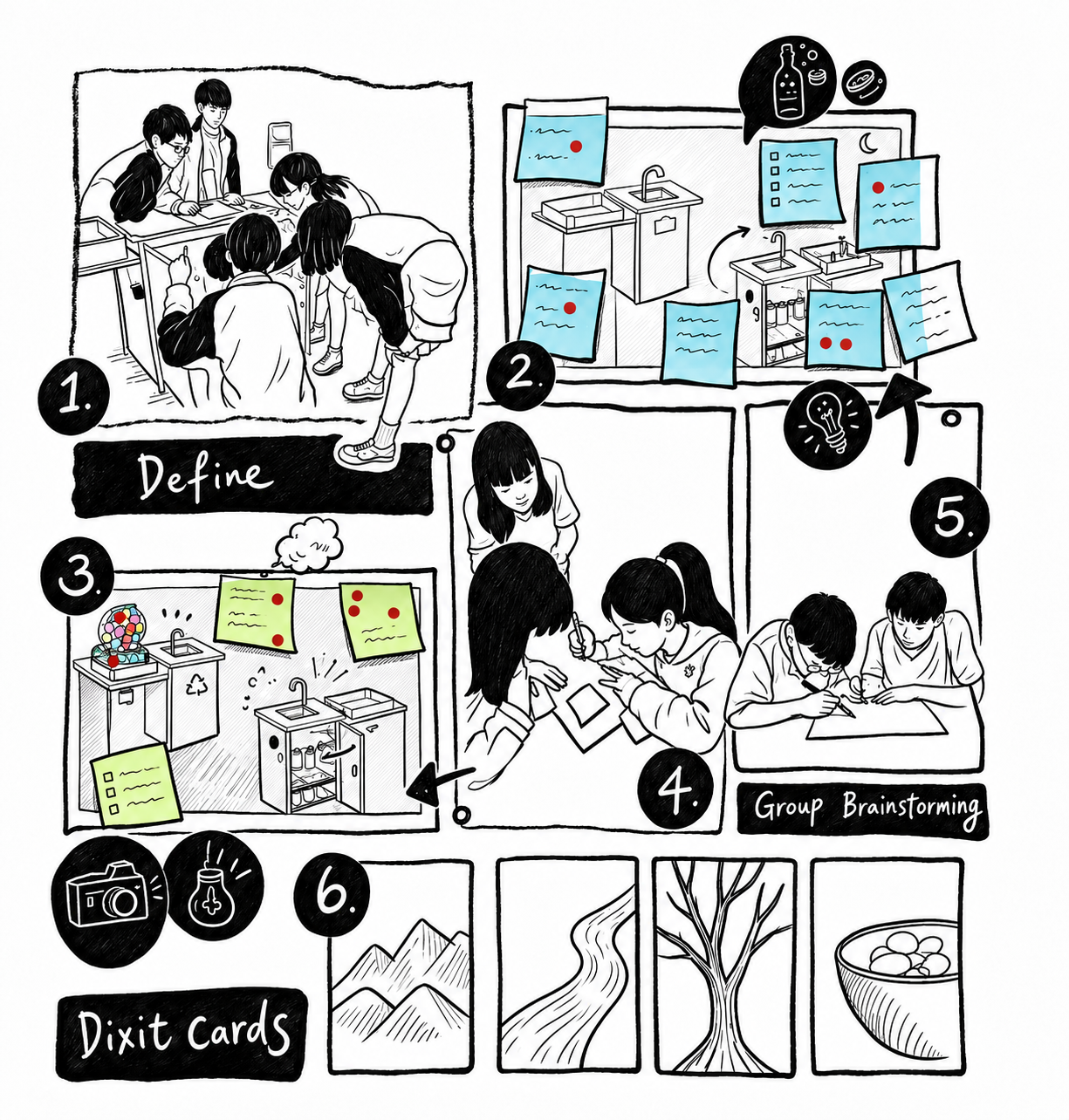
Note. The comic panels illustrate the Define and Ideate stages of Design Thinking. Through group brainstorming, sticky notes, design sketches and Dixit cards, participants explored possibilities for repurposing existing objects, drawing inspiration from natural environments, local cultures and everyday memories to develop the karaoke car.
Source: My doctoral thesis (Lin, 2025), Figure 16, p. 114.
註。漫畫分鏡呈現設計思考中的問題定義與創意發想歷程。參與者透過小組討論、便利貼、設計草圖及圖像聯想卡牌(Dixit Cards),探索既有物件再利用的可能,並將自然環境、在地文化與生活記憶轉化為走唱車的創作靈感。
來源:本人博士論文(Lin, 2025),圖16,第114頁。
