Taitung Artist Residency:
Vending Bike and Indigenous Community Landscapes
臺東藝術家駐村:移動式沉浸裝置與原民部落地景
Location: Taitung County, Taiwan
Timeline: 26 September 2022 – 31 May 2023
Commissioning Body: Taitung County Government Cultural Affairs Bureau; New Media Advancement Project, Taipei National University of the Arts (TNUA).
Collaborating Partner: Professor Yu-Ling Wu, Taipei National University of the Arts (TNUA)
Artist Team: Hsin-Mei Lin, Lien-Hung Chen, Nien-Sheng Chen
From 2022 to 2023, with funding support from the Cultural Affairs Department of the Taitung County Government and the New Media Advancement Programme at Taipei National University of the Arts, I served as the artistic director of this project, leading an interdisciplinary team of theatre designers, performing artists, and visual artists in an artistic exploration that brought together local culture and digital technology in Taitung, Taiwan.
Our creative journey began with everyday life in Taitung. The region’s rich Indigenous musical traditions, food culture, and memories of traditional markets inspired us to reimagine a long-abandoned pedal-powered vending cart. Through Design Thinking and interdisciplinary collaboration, participants and artists developed ideas together, gradually transforming an everyday object carrying memories of local life into a new work of art.
During the COVID-19 pandemic, restrictions on face-to-face interaction encouraged us to explore alternative forms of artistic expression. Using Mixed Reality (MR) technology, the team recreated the physical vending cart as a 3D digital model and developed a digital archive incorporating interactive elements. Through this integration of physical and virtual experiences, Taitung’s local stories could reach wider audiences and open up new possibilities for cultural exchange beyond geographical boundaries.
地點:臺灣臺東縣
執行期間:2022 年 9 月 26 日至 2023 年 5 月 31 日
委託單位:臺東縣政府文化處、國立臺北藝術大學新媒體精進計畫
合作夥伴:北藝大吳玉鈴老師
藝術家團隊:林欣美、陳連翃、陳念聖
2022 至 2023 年,在臺東縣政府文化處與國立臺北藝術大學新媒體精進計畫的補助支持下,我擔任本計畫的藝術指導,帶領來自劇場設計、表演藝術與視覺藝術領域的創作夥伴,在臺東展開一場結合地方文化與數位科技的藝術實驗。創作從臺東的日常生活展開。當地豐富的原住民族音樂、飲食文化與傳統市場記憶,啟發我們重新思考一輛閒置已久的腳踏叫賣車。透過設計思考(Design Thinking)與跨領域共創,參與者和藝術家共同發展創意,讓承載地方生活記憶的舊物件逐漸轉化為新的藝術作品。疫情期間,實體交流受到限制,也促使我們探索不同的創作形式。團隊運用混合實境(Mixed Reality, MR)技術,將實體叫賣車建構為 3D 數位模型,並整合互動素材與數位典藏,讓臺東的地方故事得以透過虛實交織的藝術體驗,延伸至更廣泛的觀眾與文化交流空間。
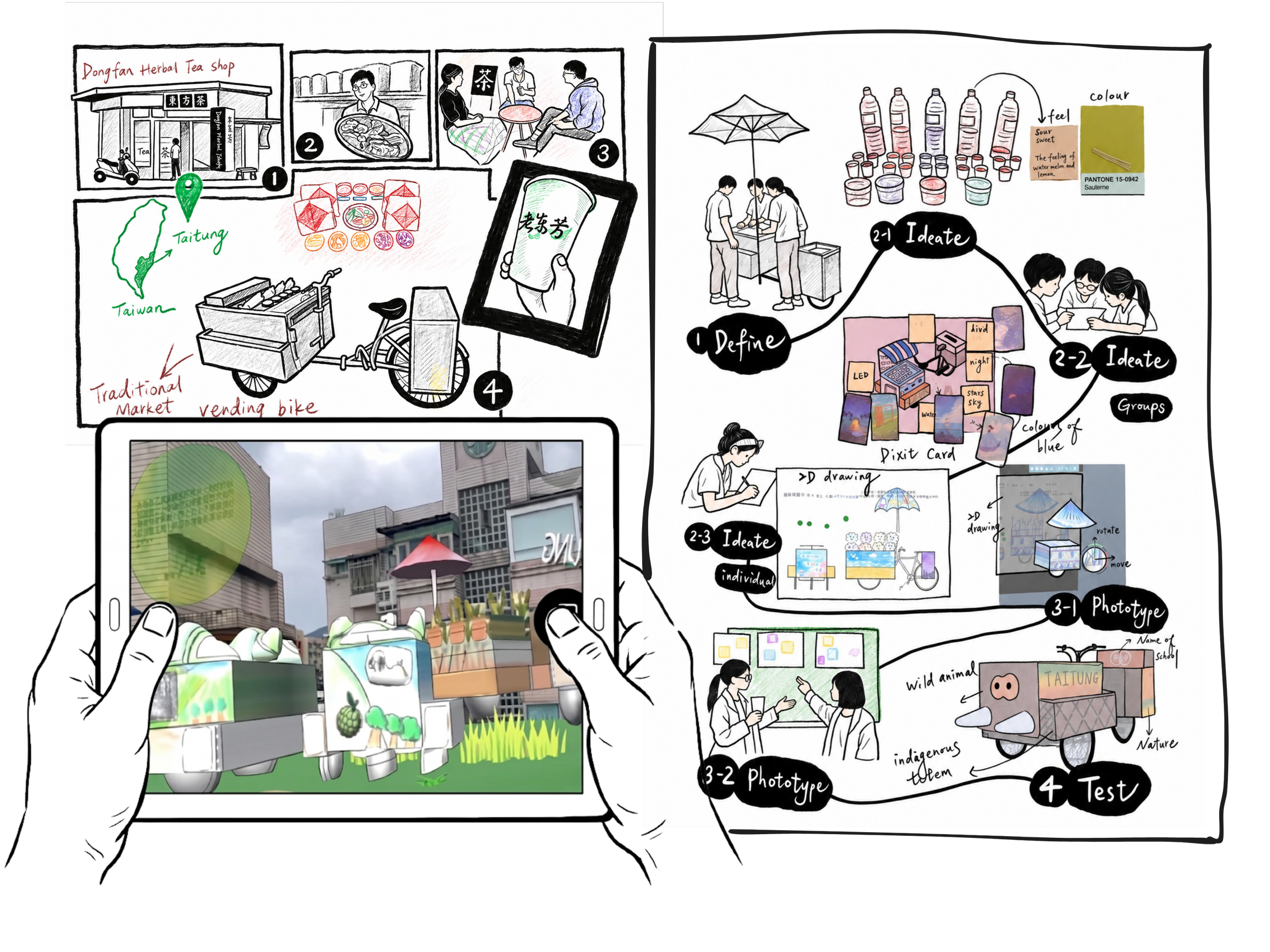
Note. The images illustrate the creative process of developing a pedal-powered vending cart, from exploring Taitung’s local culture and applying Design Thinking to creating a Mixed Reality (MR) experience. Top left: Participants visit a traditional herbal tea shop, explore local food culture, and exchange ideas to develop their initial concepts; Right: Through Design Thinking, participants move from defining problems and generating ideas individually and collaboratively to 2D design, 3D prototyping, and testing; Bottom left: Using tablets and MR technology, participants integrate a digital vending cart into a real-world street environment, exploring possibilities for interaction between physical and virtual spaces.
註。圖像呈現「腳踏攤車」從臺東在地文化探索、設計思考到混合實境(MR)創作的歷程。左上: 參與者走訪傳統青草茶店,透過飲食體驗與交流,蒐集在地文化元素,發展腳踏攤車的創作構想;右側: 運用設計思考(Design Thinking),經歷問題定義、團體與個人發想、2D 設計、3D 原型製作與測試,逐步完成攤車設計;左下: 透過平板與混合實境技術,將數位腳踏攤車融入真實街道場景,探索虛實互動的可能性。
Building on the design thinking process, participants used 3D modelling techniques to transform their 2D designs into three-dimensional creations. To explore more of the creative process and outcomes, visit the Artist Residency Project website below.
延續設計思考的創作歷程,參與者將 2D 設計轉化為3D 建模的立體作品。更多創作過程與成果,歡迎至下方的藝術家駐村計畫網站探索。
Note. An interactive 3D model of the student-created mobile singing cart, allowing viewers to freely rotate and explore structural details.
註。學生共創走唱車之 3D 互動數位模型,觀眾可自由翻轉與探索車體結構細節。
Click the image above or the link below to visit the Artist Residency Project website and explore the creative process and final works.
點擊上方圖片或下方連結,即可進入藝術家駐村計畫網站,探索完整的創作歷程與作品成果。